
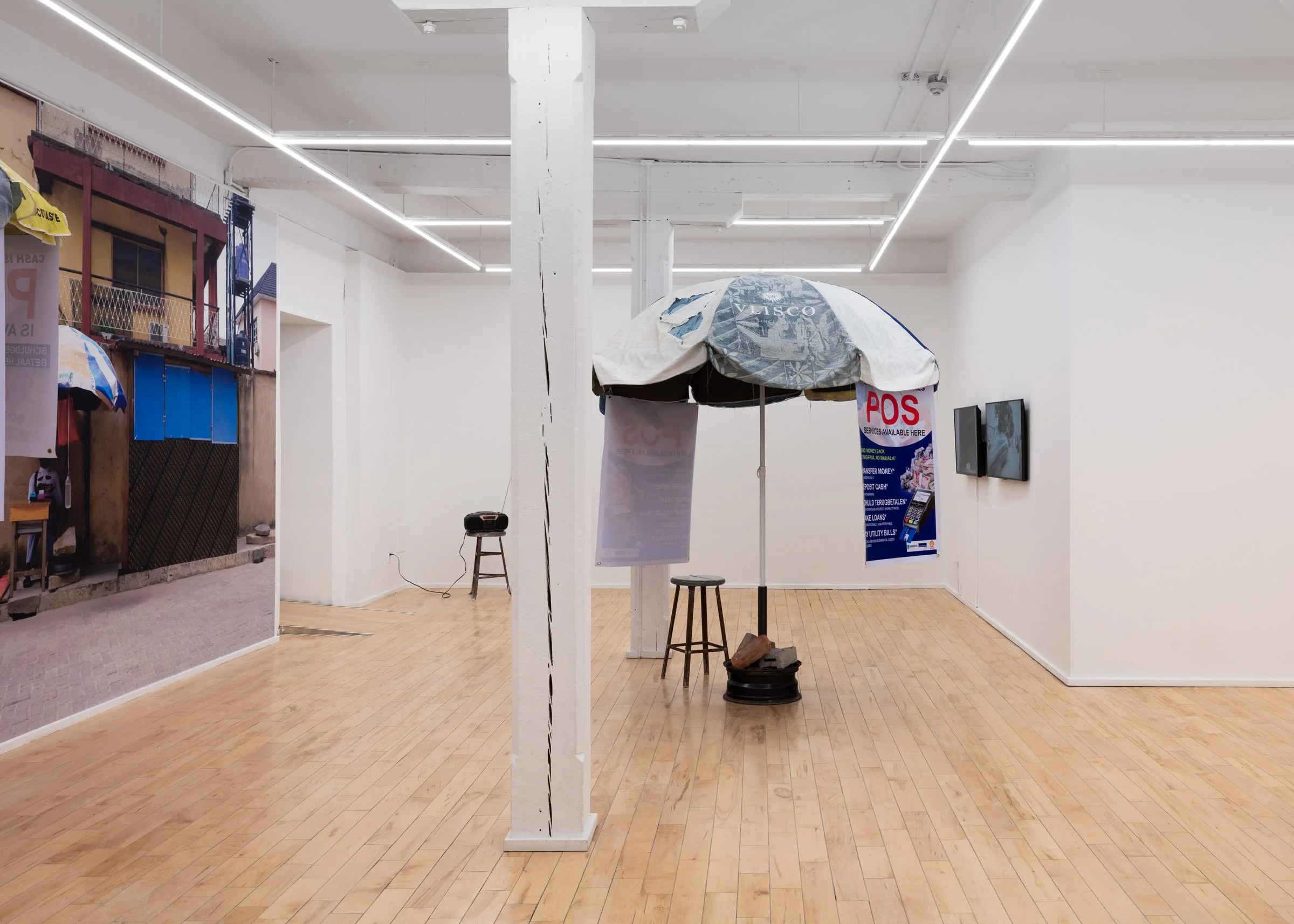
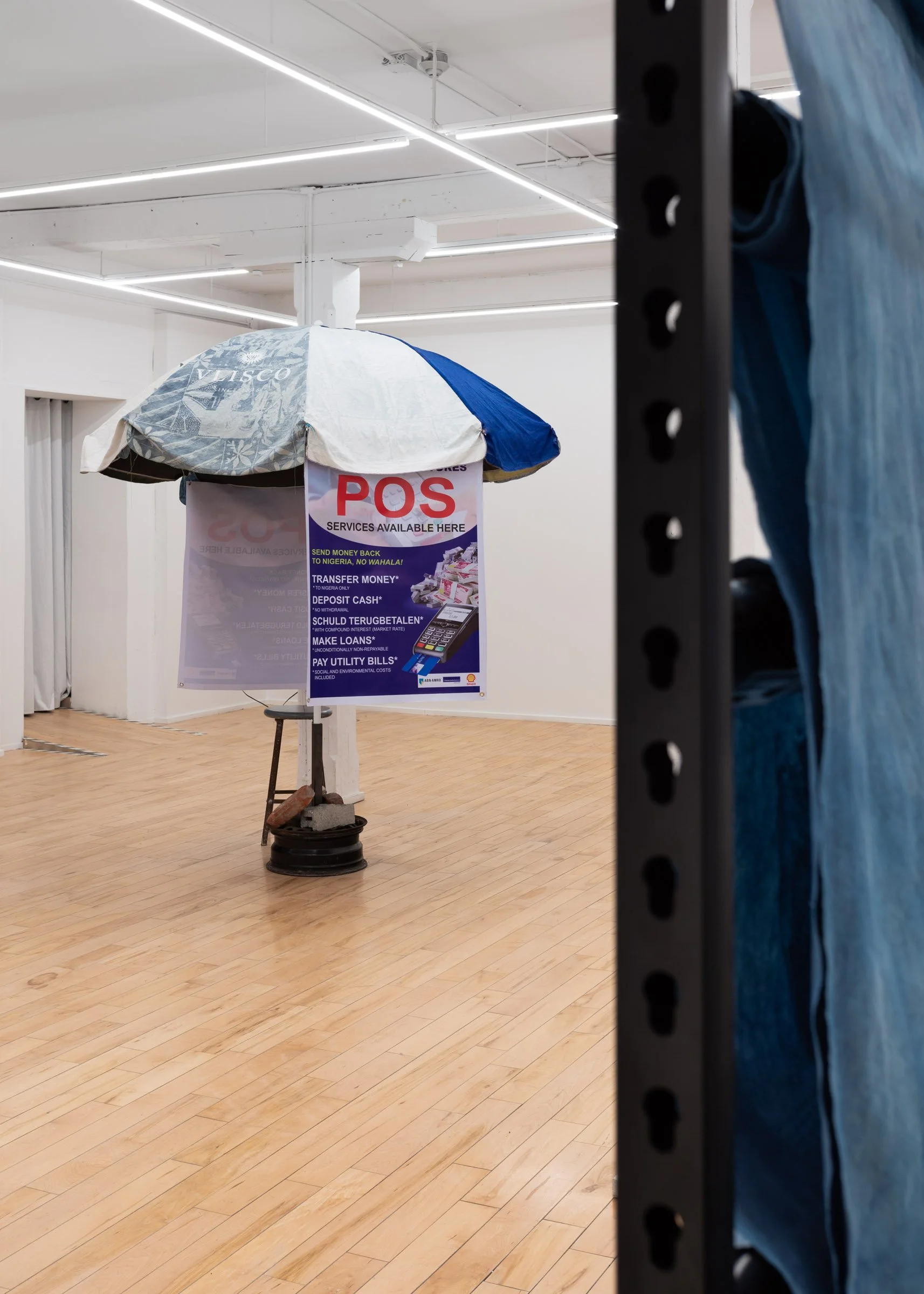
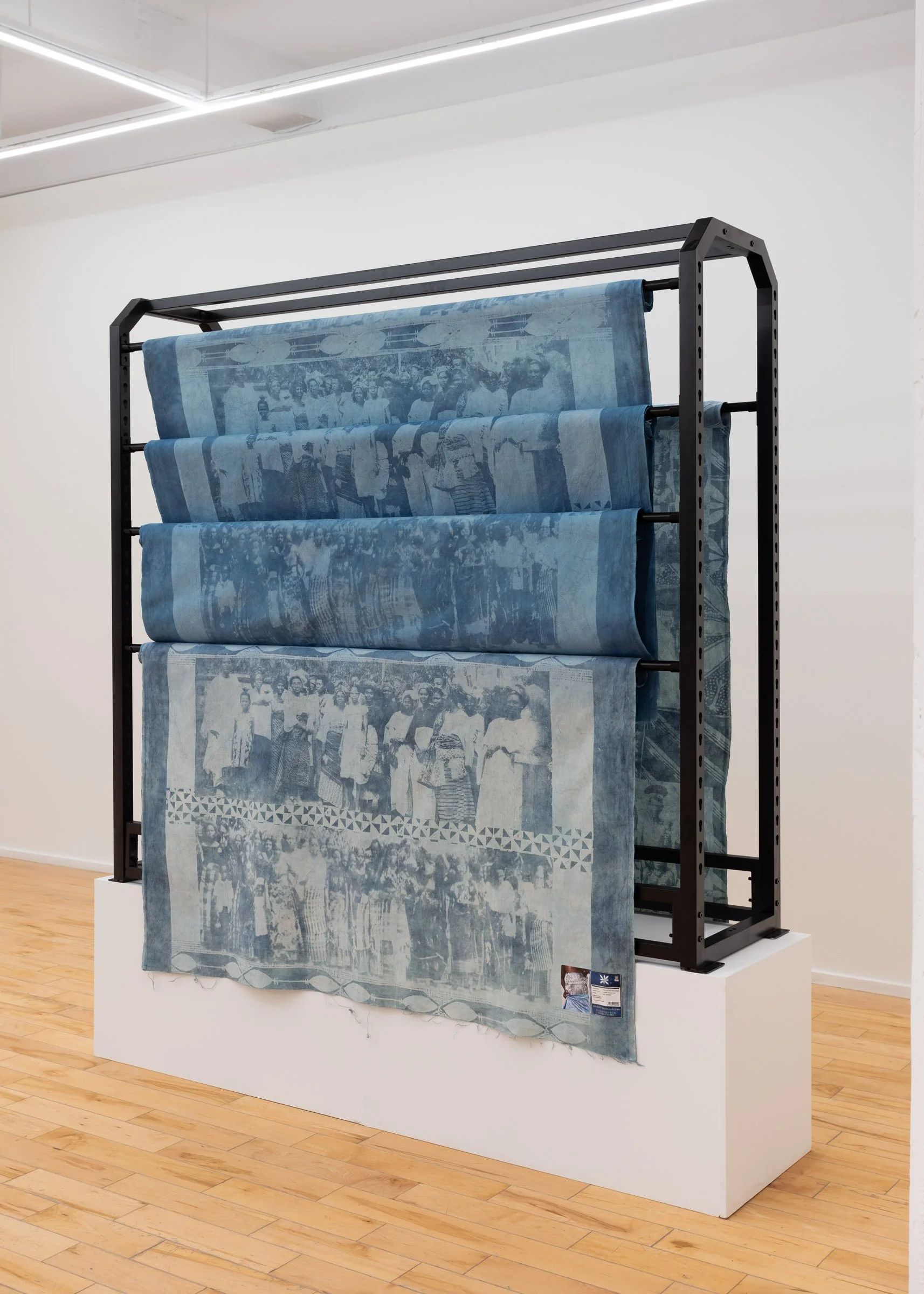
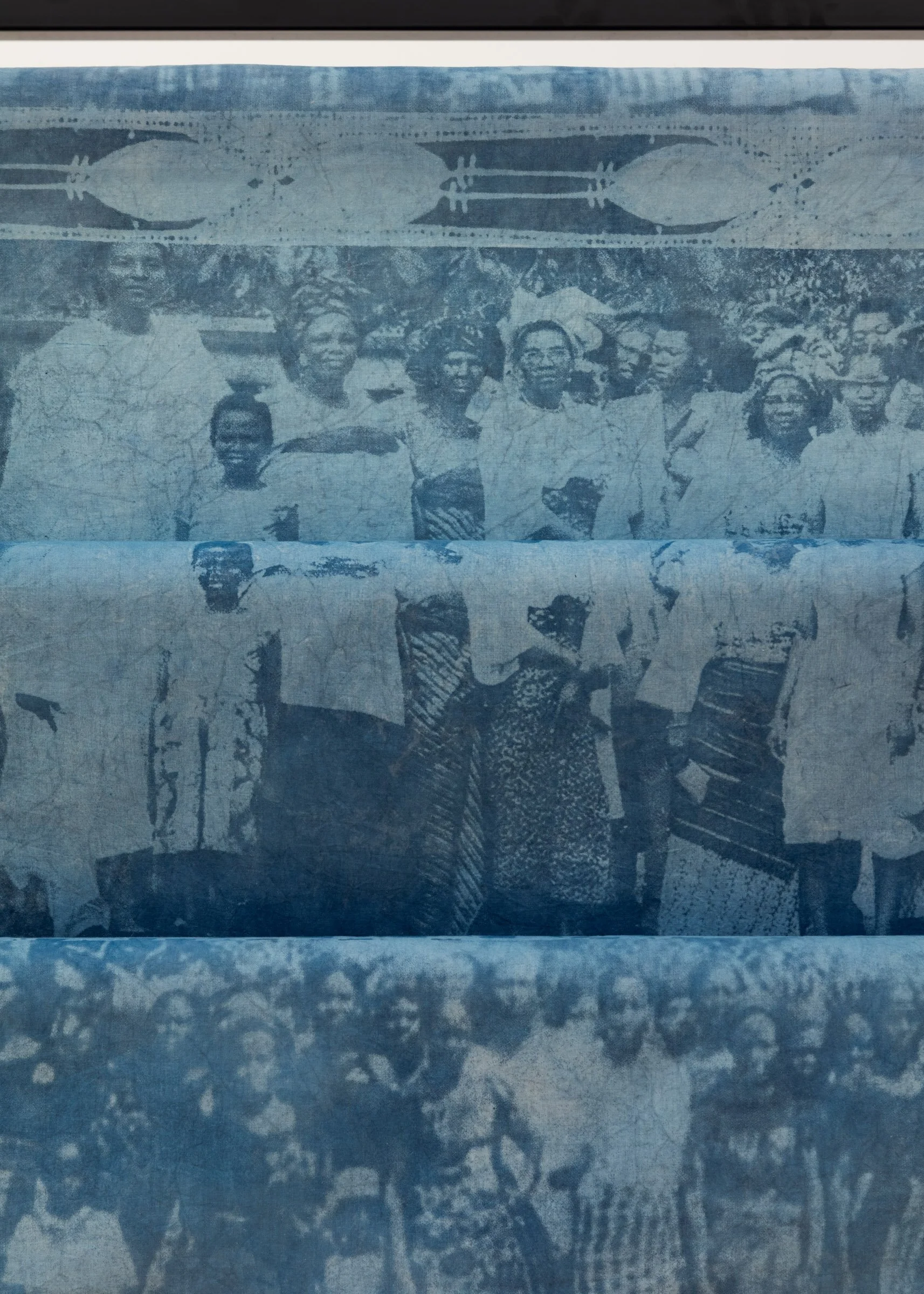
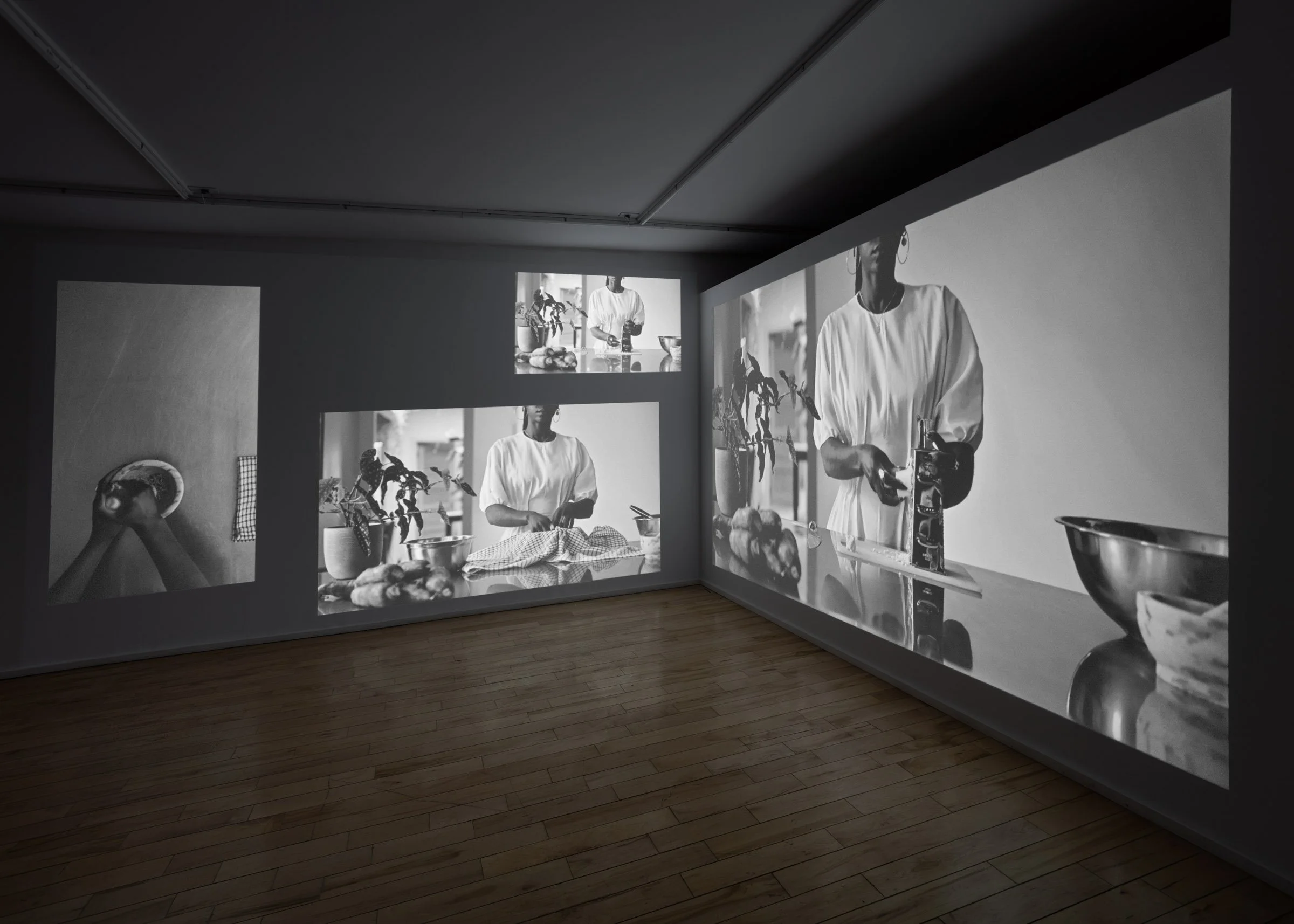
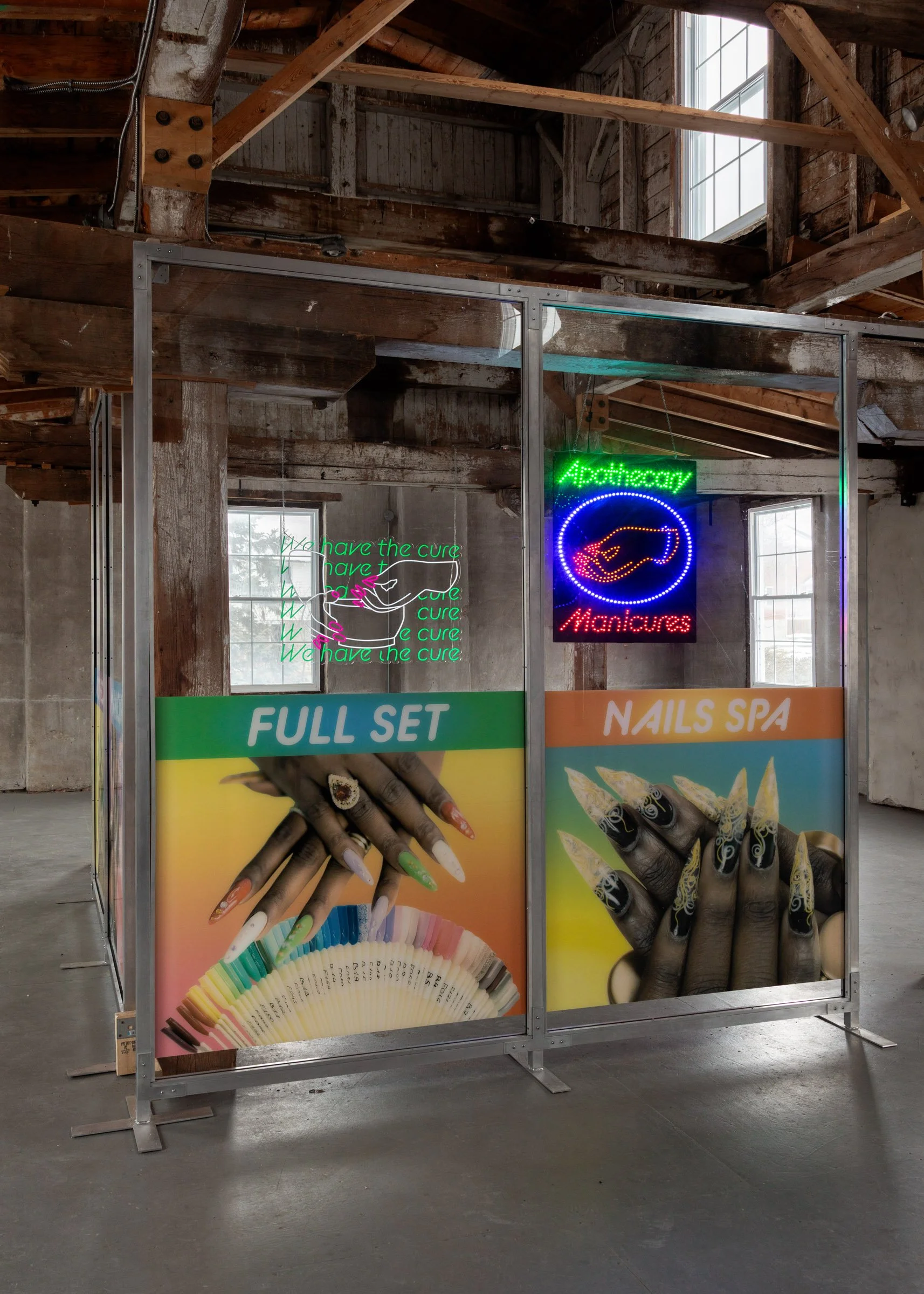
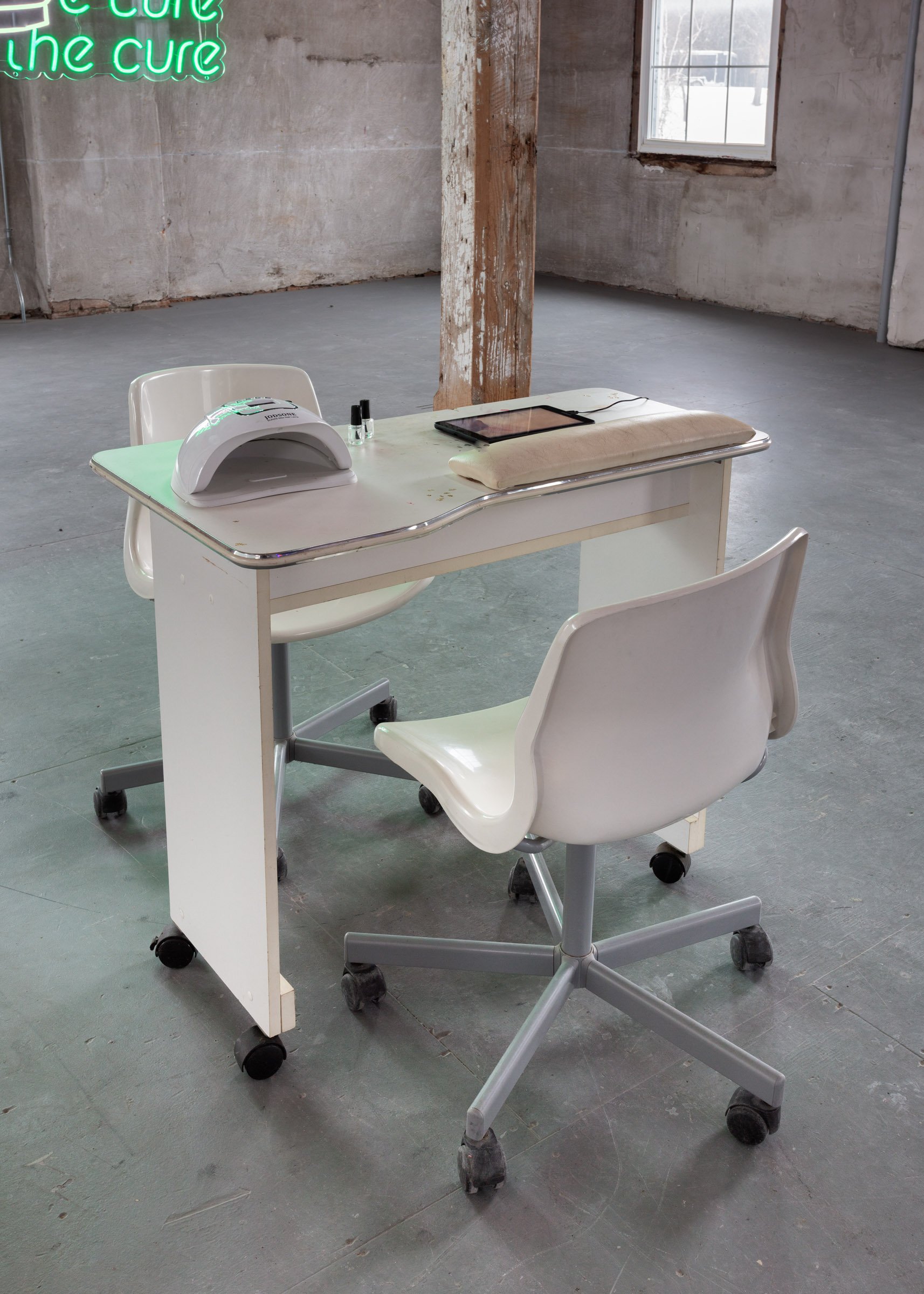
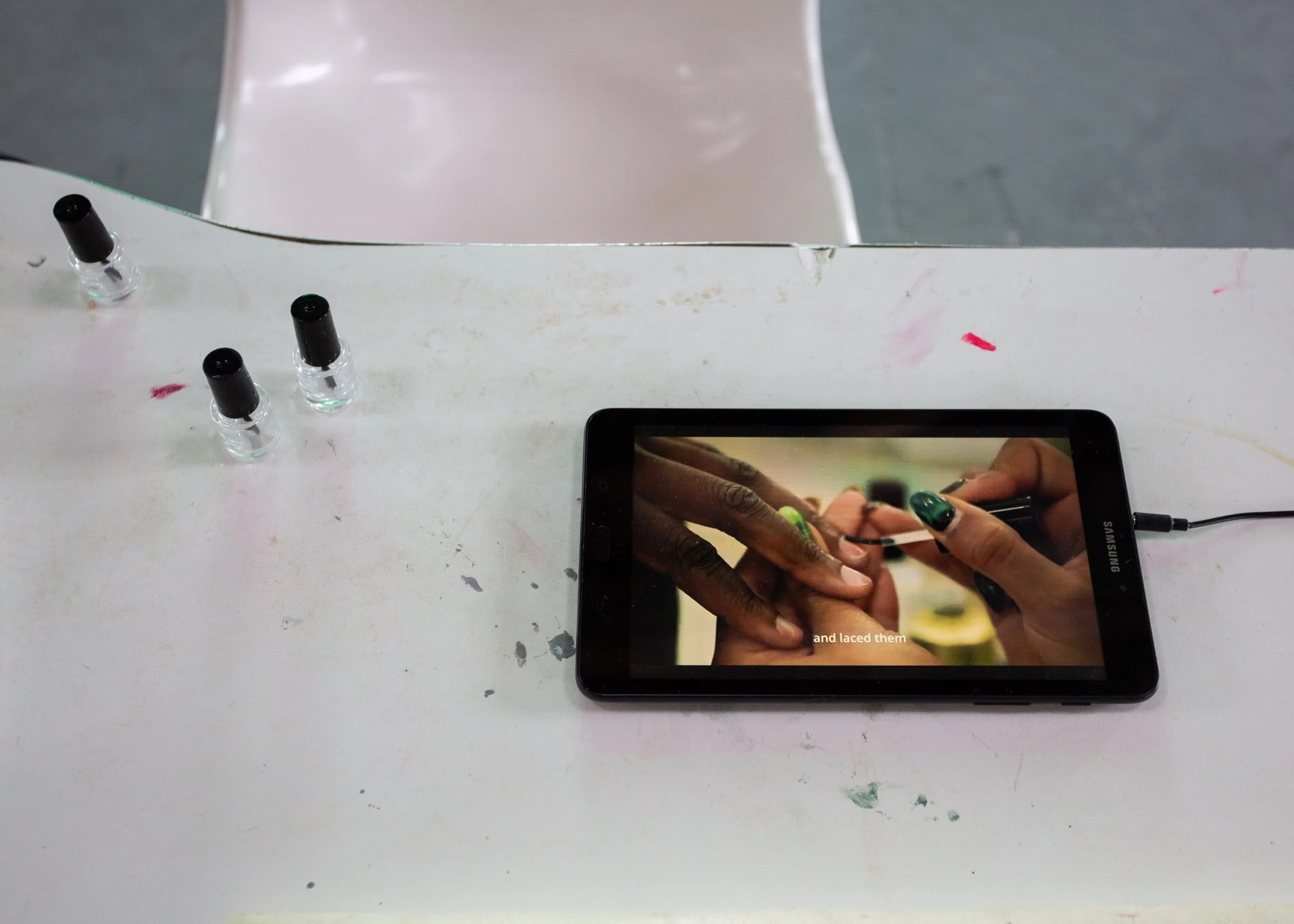
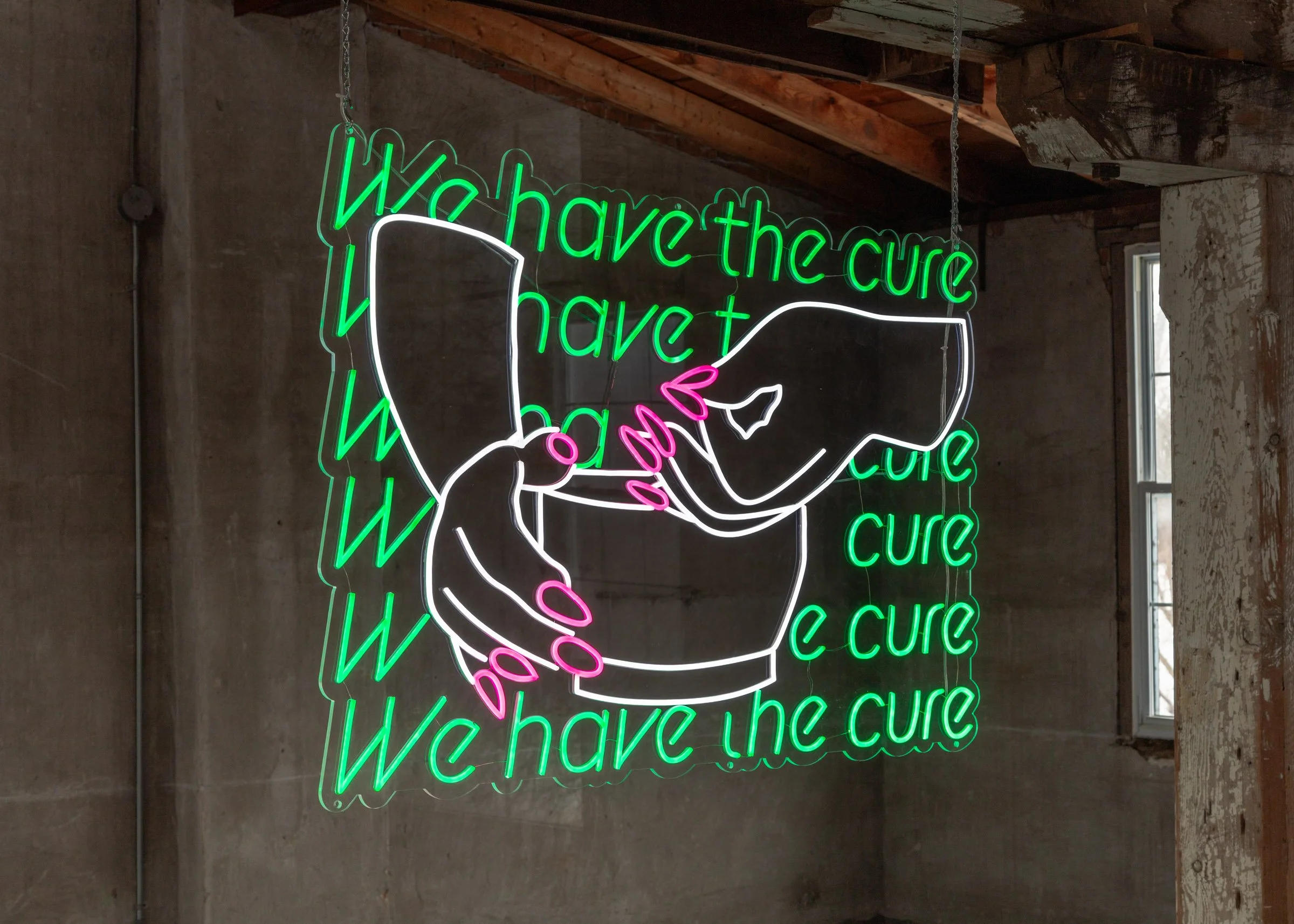
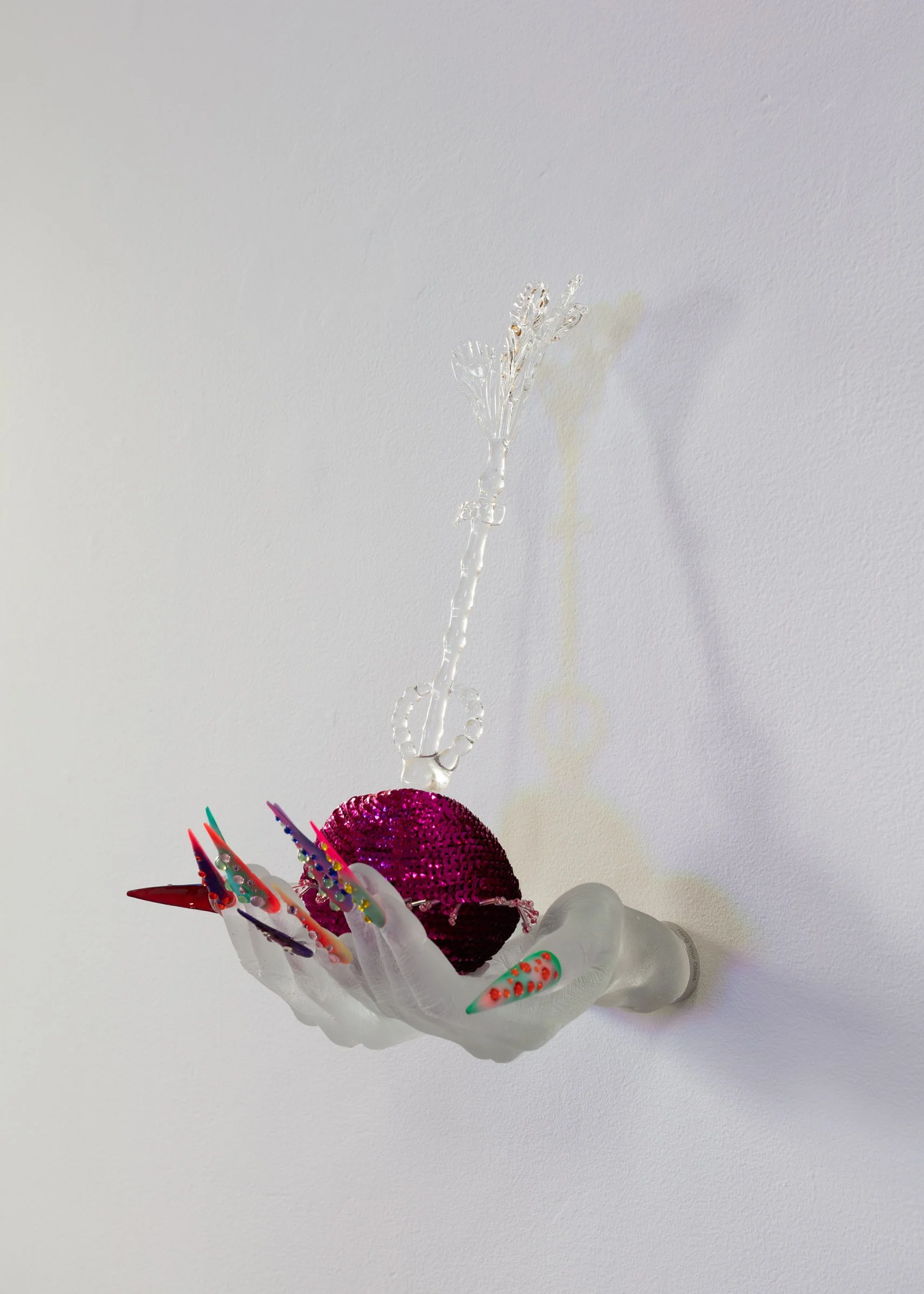
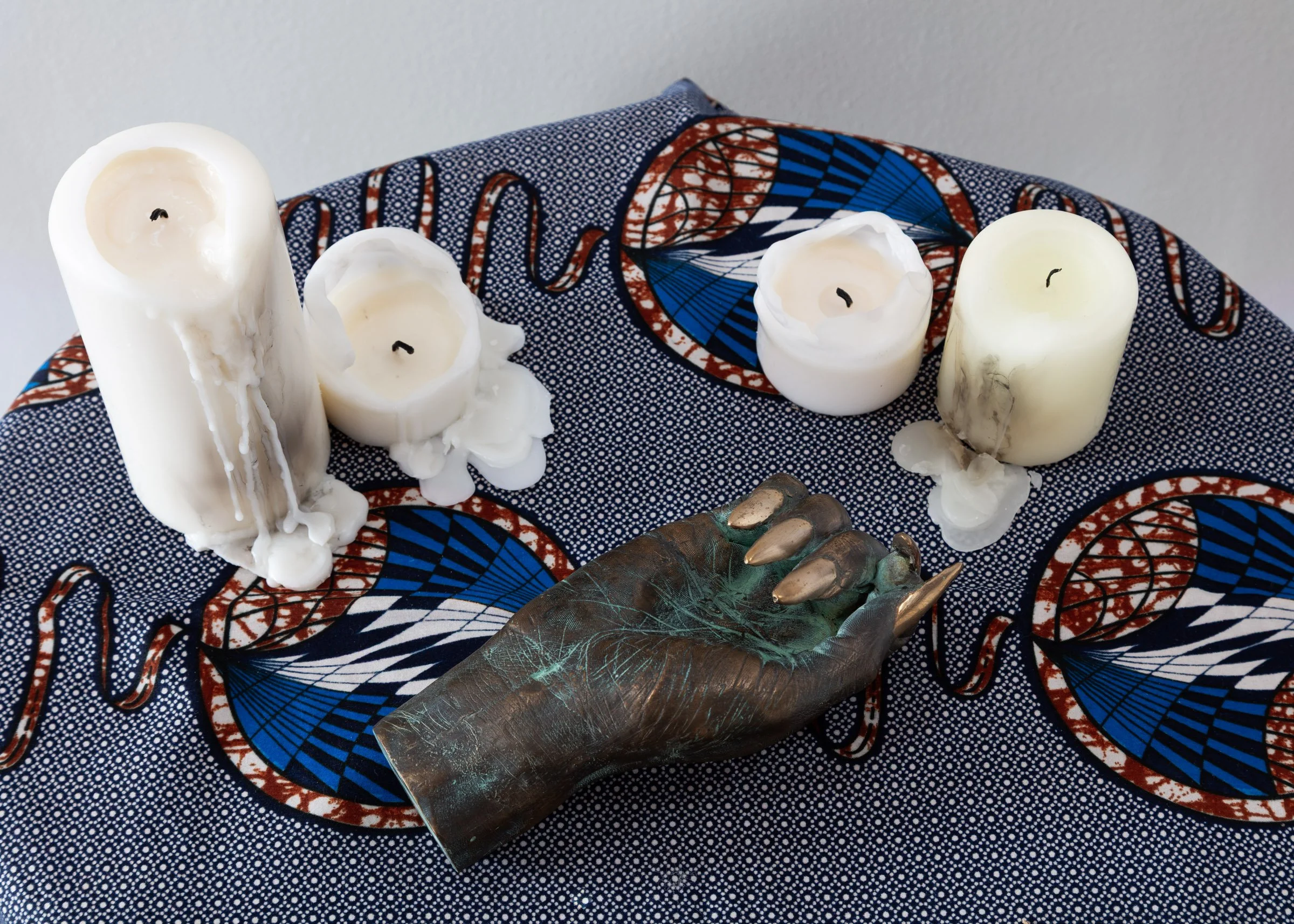
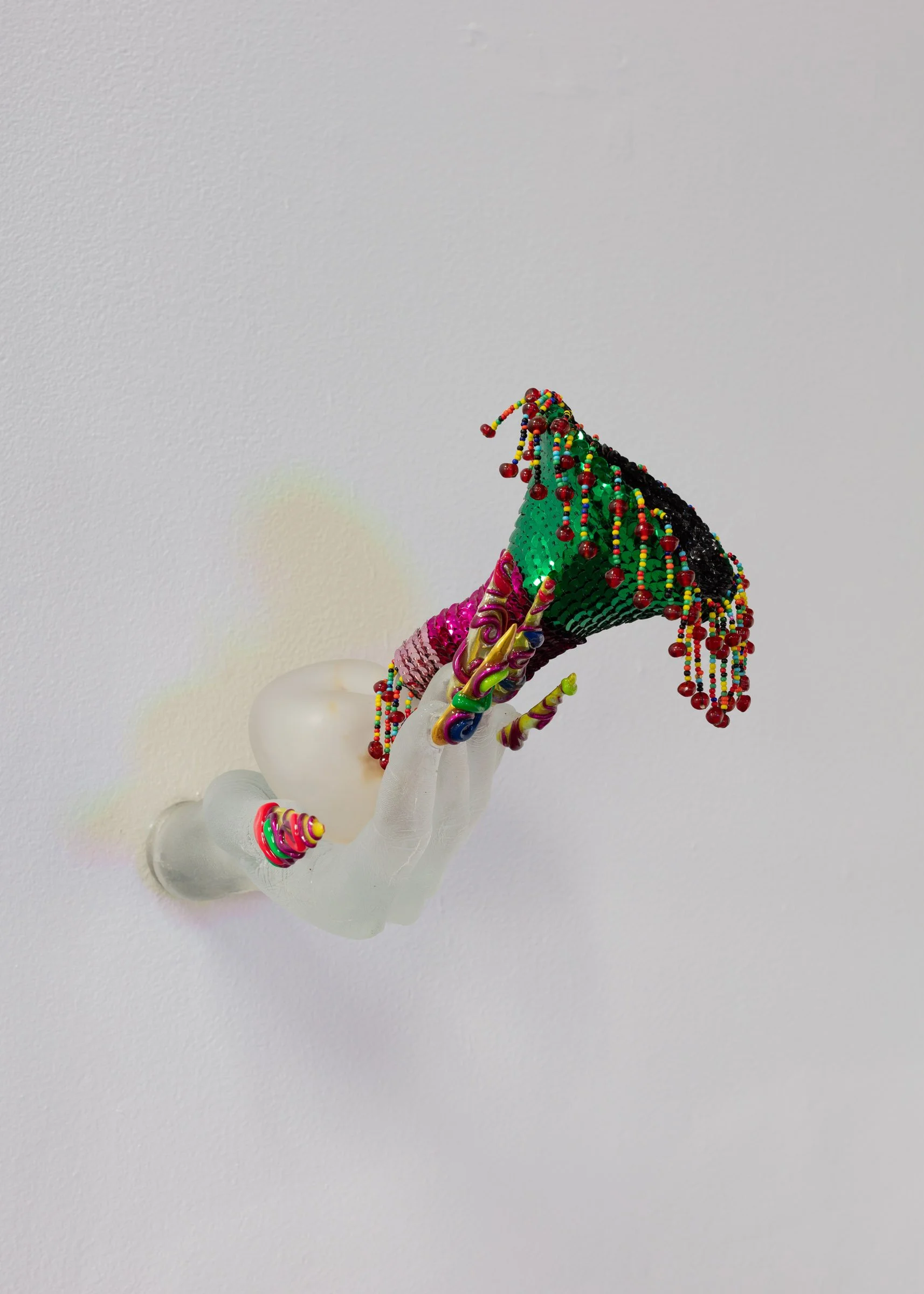
Installation views of ‘We Have The Cure’, featuring Kosisochukwu Nnebe at the Visual Arts Centre of Clarington, 2026. Photos by LF Documentation
We Have The Cure
Kosisochukwu Nnebe
Visual Arts Centre of Clarington
January 31 - June 2, 2026
Opening Reception + Artist Talk:
Saturday, January 31st, 2 - 4 PM
Curated by:
Megan Kammerer and Samantha Lance
In the beginning, there was a root. Cassava, which originated in South America and the Caribbean before becoming central to West African foodways, is now a staple in Nigerian cuisine. This starchy vegetable must be carefully prepared to remove cyanide toxins from its flesh. The root has been pulled from the earth for generations by women who knew its dual nature—food and poison, sustenance and sabotage. Records tell us that some enslaved Black women hid traces of the root beneath their fingernails, carrying a quiet insurgency in the smallest crease of the body. With each chore of service, each gesture of labour, these women courted the possibility of revolt. Their hands became sites of strategy: nail beds as thresholds between survival and refusal, protection and empowerment.
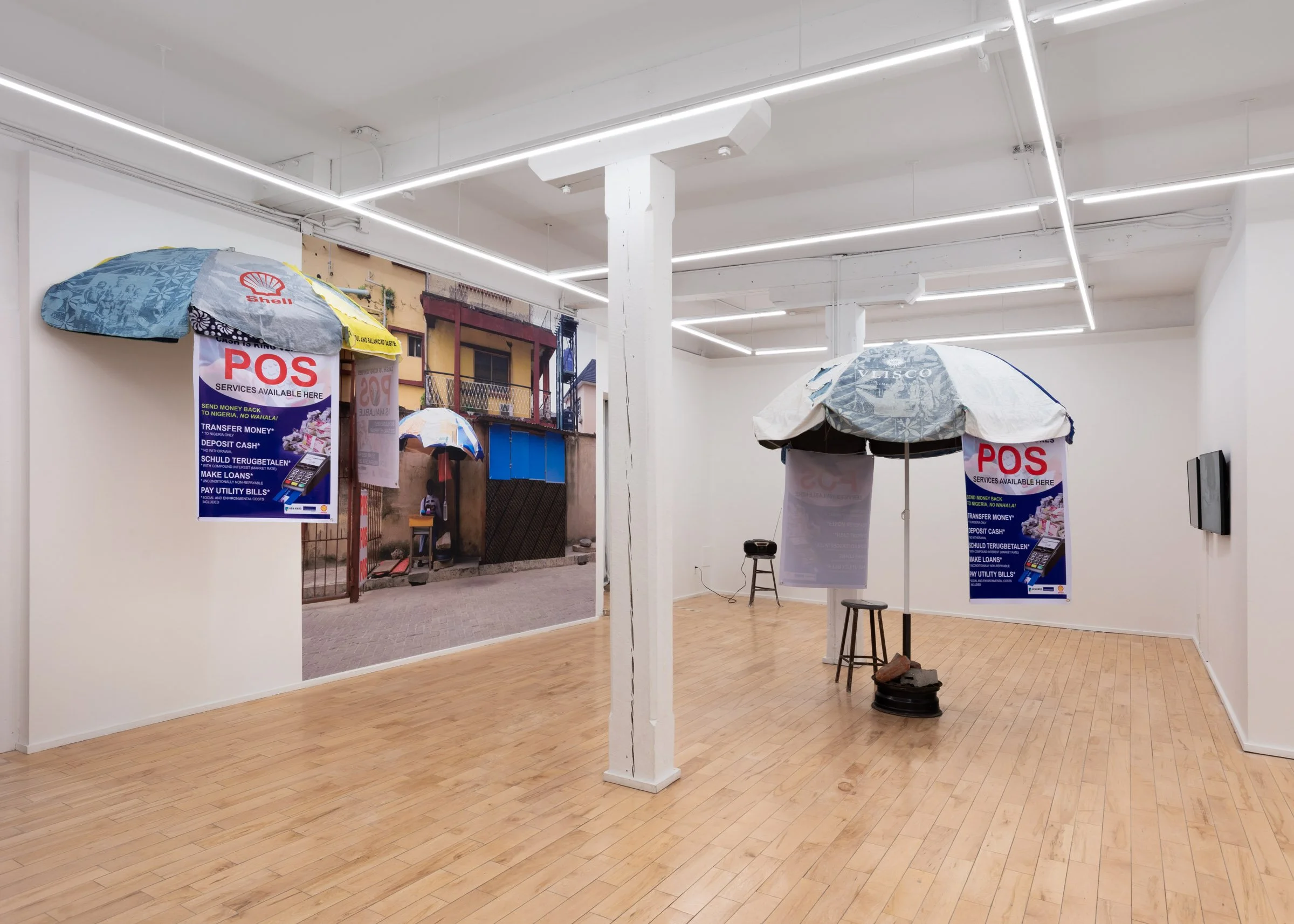
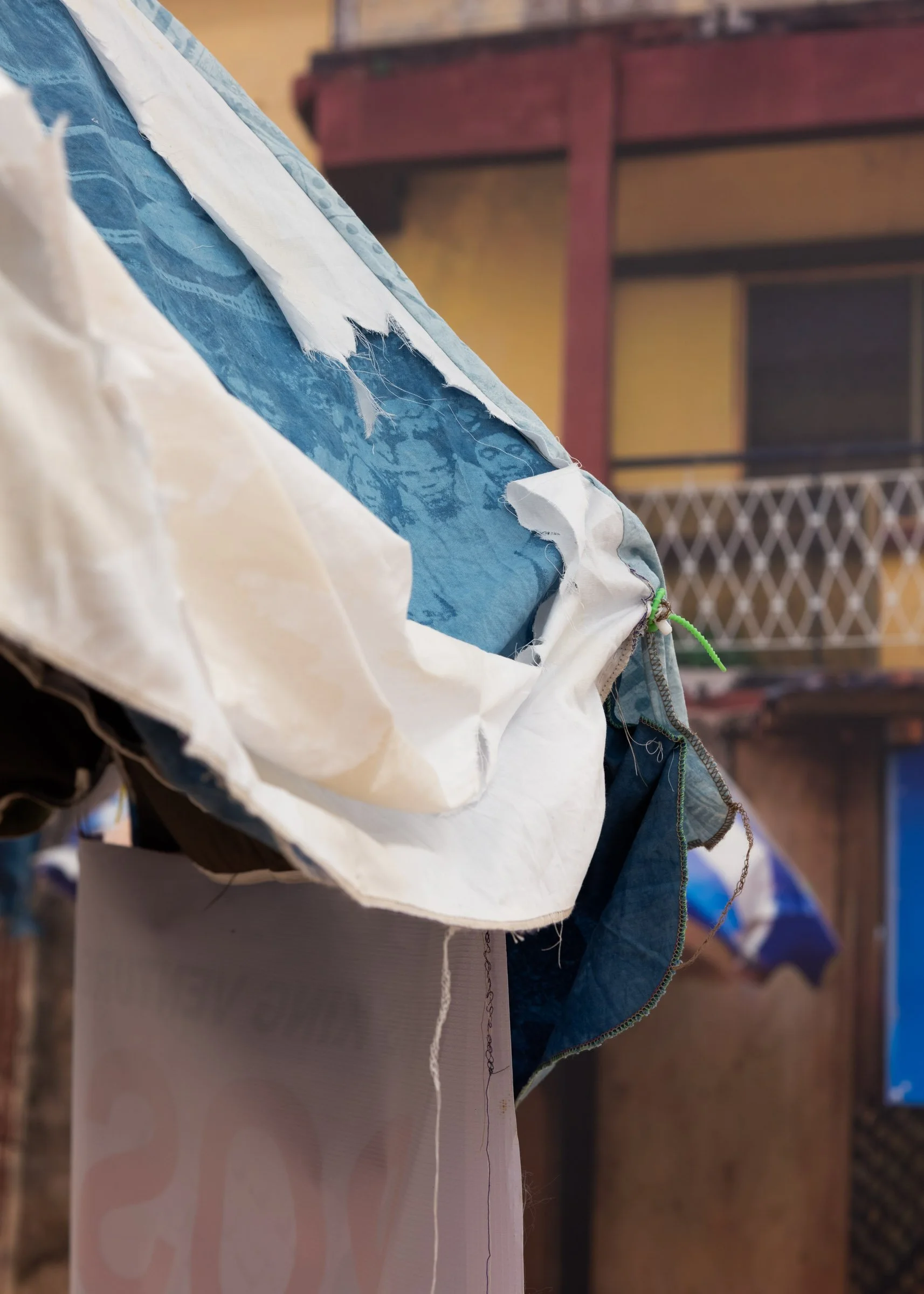
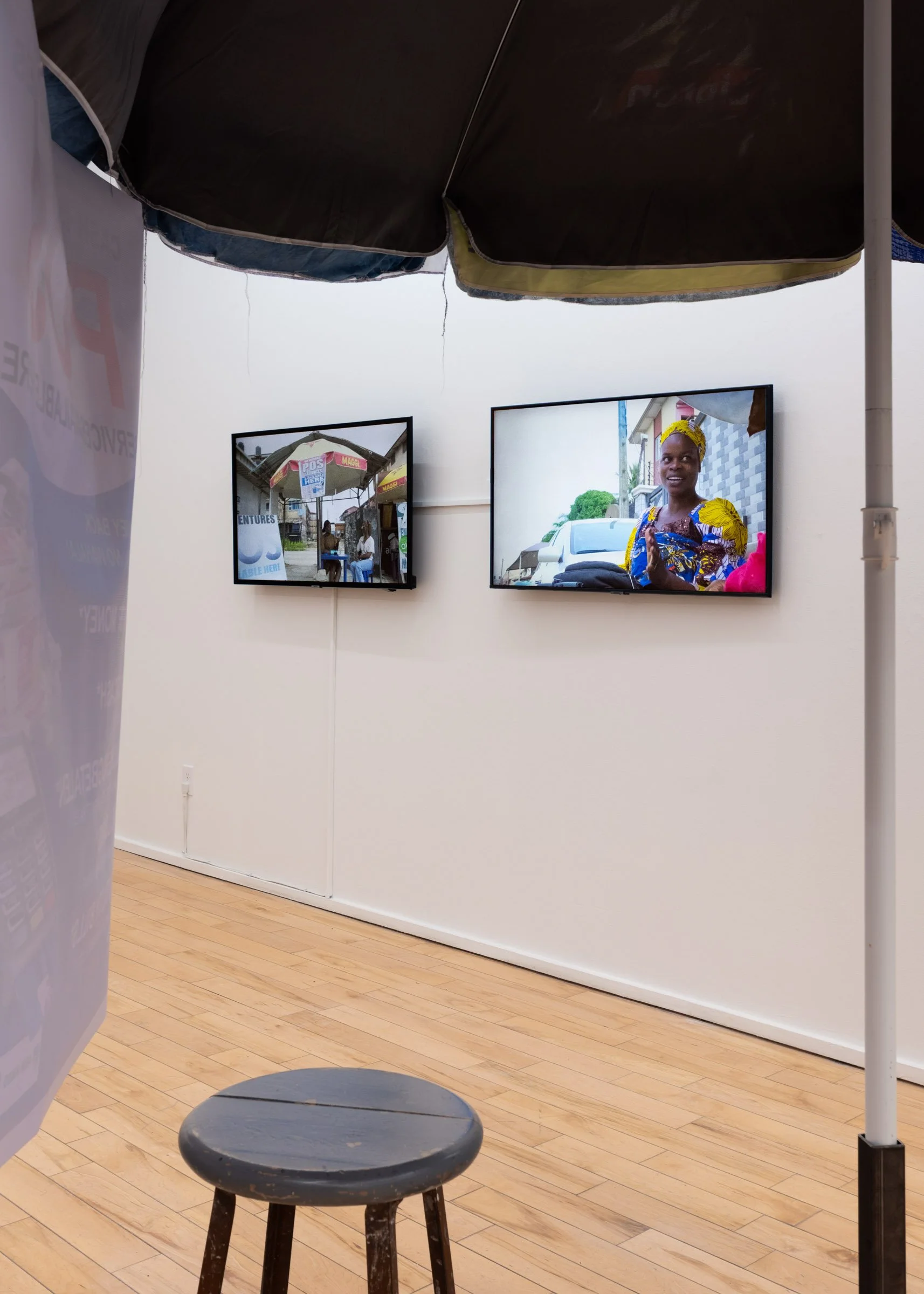
Kosisochukwu Nnebe’s We Have The Cure is a multimedia installation that extends from the wake of this sisterhood. It asks what becomes of this ancestral tactic—this poison feminism—as it travels across oceans, centuries, plantations, marketplaces, and digital economies. What remains at the fingertips of women today, and how do their hands continue to engineer liberation in a world structured against their flourishing? As Nnebe extends the cosmology of her previous work in The Seeds We Carry (2024), her textile, video and sculptural installations trace a lineage of uncompromising Black feminist innovation: from cassava hidden under fingernails to adire cloth dyed in courtyards; from historical rebellion in plantation kitchens to contemporary credit cards tapped on Point-of-Sale terminals that connect buyers in North America and Europe directly to market women in Nigeria.
In Lagos, women build their own micro-economies from scratch –crafting adire cloth in dye pits or providing access to cash in market stalls – while navigating conditions that consistently deny them financial stability. In North America, nail salon technicians create similar sites of freedom, expression, and autonomy. Their labour in each case is creative, entrepreneurial, and political. How can we learn from these ongoing traditions to uplift new avenues for community-building, and emancipation? The cure has always been in our hands—with dye-stained palms, lacquered nails, fingers that continually make, resist, and reimagine. Liberation is not a distant horizon but a practice already pulsing, ready for action, at our fingertips.
Exhibition Resources:
Exhibition Programming:
The VAC invites you to attend our Opening Reception on Saturday, January 31, 2025, from 2 - 4 PM. Curators Megan Kammerer and Samantha Lance will lead a curatorial tour and discussion with exhibiting artist Kosisochukwu Nnebe, guiding visitors through the exhibition's dynamic mixed media works from 2:30 - 3 PM.
Visitors from Toronto are invited to take a free shuttle bus to the VAC, departing fromFactory Theatre at 12:45 PM on Saturday January 31, 2025. Registration for the shuttle bus is required. Visit our events page for more details.
About the Artist:
Kosisochukwu Nnebe (She/her) is a neurodivergent Nigerian-Canadian conceptual artist and researcher working across installation, lens- and time-based media, textiles and sculpture. Through a research-based and pedagogical practice, she rethinks historical narratives by centring the agency and emotional worlds of Black women and offers transgressive representations and understandings of Blackness rooted in anti-imperial relationality.
A self-taught artist, Nnebe’s work critically unpacks her academic background in economics, development and sociology from McGill University and the London School of Economics, as well as her professional experience in social, economic, and environmental policy within the Canadian government. Inspired by her work in food and biodiversity policy, Nnebe develops a methodology for transforming foodways into counter-archives of colonial histories, tracing the migration and changing uses of crops such as cassava to recover histories of gendered resistance. Her approach to image-making incorporates ecological methods that position nature as active collaborator and medium for the materialization of archival photographs.
Beyond representation—and grounded in her work in social and economic policy—Nnebe’s practice seeks impact: fostering spaces for coalition-building between differently colonized peoples and using existing channels for the circulation of capital—both within and beyond the arts—to redistribute resources as a means of restitution and reparations.
Nnebe’s work has been shown extensively across Canada, the United States, and Europe. She is a 2025 alumnus of the Jan van Eyck Academie in the Netherlands; a 2023 Awardee of the G.A.S. Fellowship started by Yinka Shonibare CBE RA in Lagos, Nigeria; and was selected as a 2024 Artist-in-Residence with Women Photographers International Archive (WOPHA) at El Espacio 23 in Miami, Florida. Nnebe is based between Maastricht, Netherlands; Lagos, Nigeria; and Ottawa, Canada.
About the Co-Curators:
Samantha Lance (She/her) is the Curator of the Visual Arts Centre of Clarington whose work fosters meaningful connections between artists and communities. She holds a Master of Visual Studies in Curatorial Studies degree from the University of Toronto and a BFA with Distinction in Criticism and Curatorial Practice from OCAD University. Lance has worked with institutions including the Art Museum at the University of Toronto, The Power Plant Contemporary Art Gallery, C Magazine, the Art Gallery of Algoma, Onsite Gallery, and Latitude Gallery New York. Her graduating exhibition, The Love that Remains (Art Museum at the University of Toronto, 2024), brought together Toronto-based artists whose textile practices recover matrilineal histories of displacement and belonging. She continues to research and collaborate with artists and curators advocating for women’s labour, textile practices, and ancestral techniques, with a particular interest in experimental, multisensory exhibition strategies that expand accessibility and dialogue.
Megan Kammerer (She/her) is a curator, writer, and researcher based in Toronto. She has held various positions with the Robert McLaughlin Gallery, Blackwood Gallery, Jackman Humanities Institute, and the Art Gallery of Guelph, where she worked to support critically engaged exhibition programmes across Southern Ontario.
From 2022 - 2024, she was the Curator at the Visual Arts Centre of Clarington, where she spearheaded the gallery's artistic direction and facilitated site-specific installation projects. She collaborates with artists and local communities to navigate broad disruptions in our collective relationships, environments, technologies, and identities. Through large-scale happenings and site-specific sculptural commissions, she aims to interrupt, reimagine, and reimage new futures for public space. Her work has been shortlisted for three exhibition awards, winning an Exhibition of the Year prize from Galeries Ontario / Ontario Galleries in 2023. Kammerer's research is published by the University of Toronto, where she holds an Honours Bachelor of Arts in Art History. She currently works as a Programming Associate at The Bentway.
Accessibility:
The VAC is not yet fully accessible, with stairwell access to our third-floor Loft Gallery. Please email us if you require additional accommodations so we can meet your needs or provide additional seating as required.

We Have The Cure is organized by the Visual Arts Centre of Clarington with support from the Canada Council for the Arts, the Ontario Arts Council, The Government of Ontario, and Municipality of Clarington.


